



How Do You Pick the Right Size for Your Custom Pins

Adeel Qayum
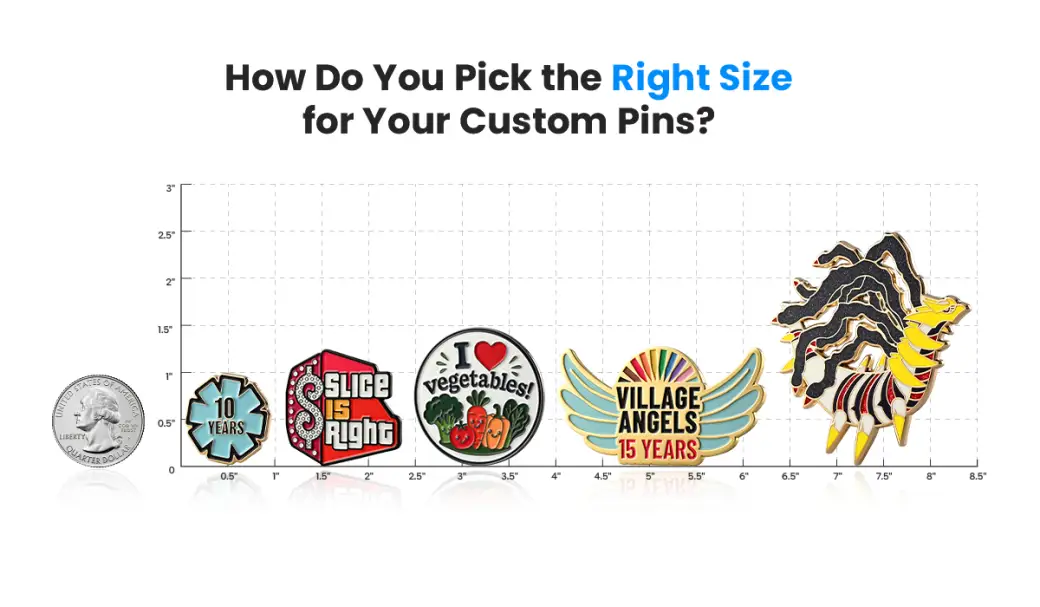
Choosing the right custom pin size isn't just about picking 'a little bigger' or 'a little smaller'—it’s about balancing design details, wearing comfort, and overall visual impact. When the size is too small, intricate patterns, fine printing, or brand logos may be hard to see; but if the size is too large, it will add to the weight and thus make it more probable that the fabric will sag or tilt when worn on thin fabrics like silk or cotton. To help you avoid unnecessary costly trial and error, GS-JJ has created this comprehensive pin sizing guide, which provides a detailed analysis of various lapel pin sizes, production process limitations, and design considerations, ensuring that your custom pins are not only aesthetically pleasing, professional, and exquisite but also sturdy and durable.
Common Pin Sizes and Comparison
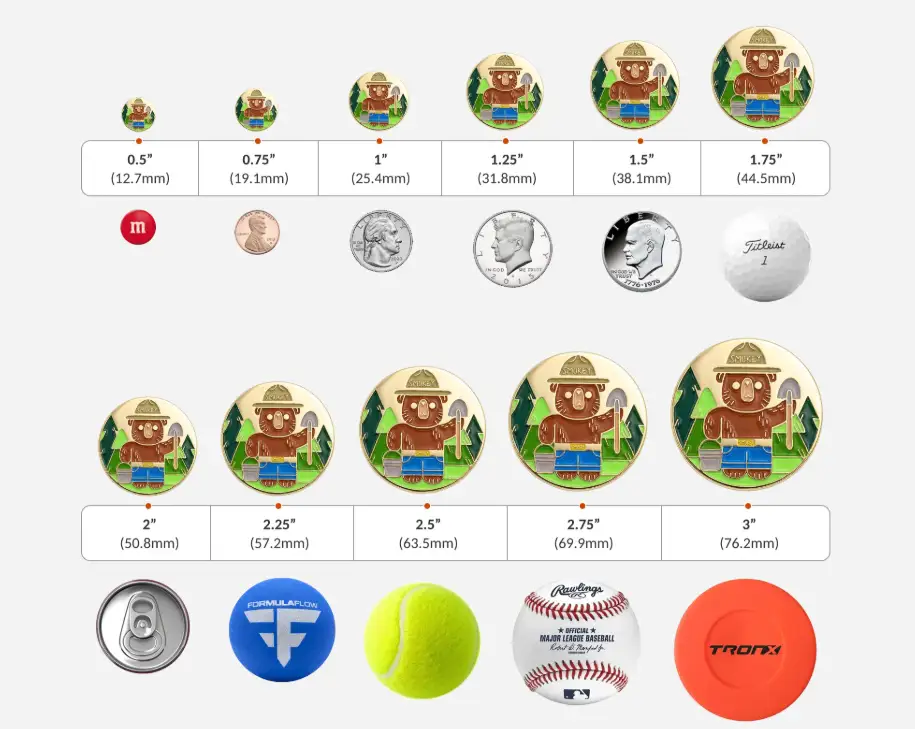
The following breakdown will help you quickly visualize how your artwork will translate into physical dimensions, as it groups the standard pin tiers with references to common objects, their main uses, and key manufacturing features.
| Size Tier | Pin Size (In / mm) | Size Reference | Best Use Cases | Key Features |
| Small Pins |
0.50" (12.7 mm) 0.75" (19.1mm) |
M&M candy US Penny |
Suit lapels, tie clips, dress shirts, service awards | Subtle & elegant, won't drag thin fabrics, lowest mold & unit cost |
| Standard Pins |
1.00" (25.4mm) 1.25" (31.8mm) |
US Quarter US Half Dollar |
Company logos, event giveaways, hats, canvas bags | Universal sweet spot, optimal balance of visibility, comfort & budget |
| Large Pins |
1.50" (38.1mm) 1.75" (44.5mm) |
Eisenhower Dollar Golf ball |
Sports trading pins, complex mascots, festival merch | Fits high-density details without crowding, usually needs double clutches |
| Jumbo Pins |
2.00" (50.8mm) 2.50" (63.5mm) 3.00" (76.2mm) 4.00"+ (101.6mm+) |
Small V8 can lid Tennis ball Hockey puck McDonald's drink lid |
Limited collectibles, interactive spinner/slider pins, display boards | Maximum visual statement, high retail value, requires heavy fabrics & multi-clutch backing |
What Factors Influence Your Custom Pin Size?
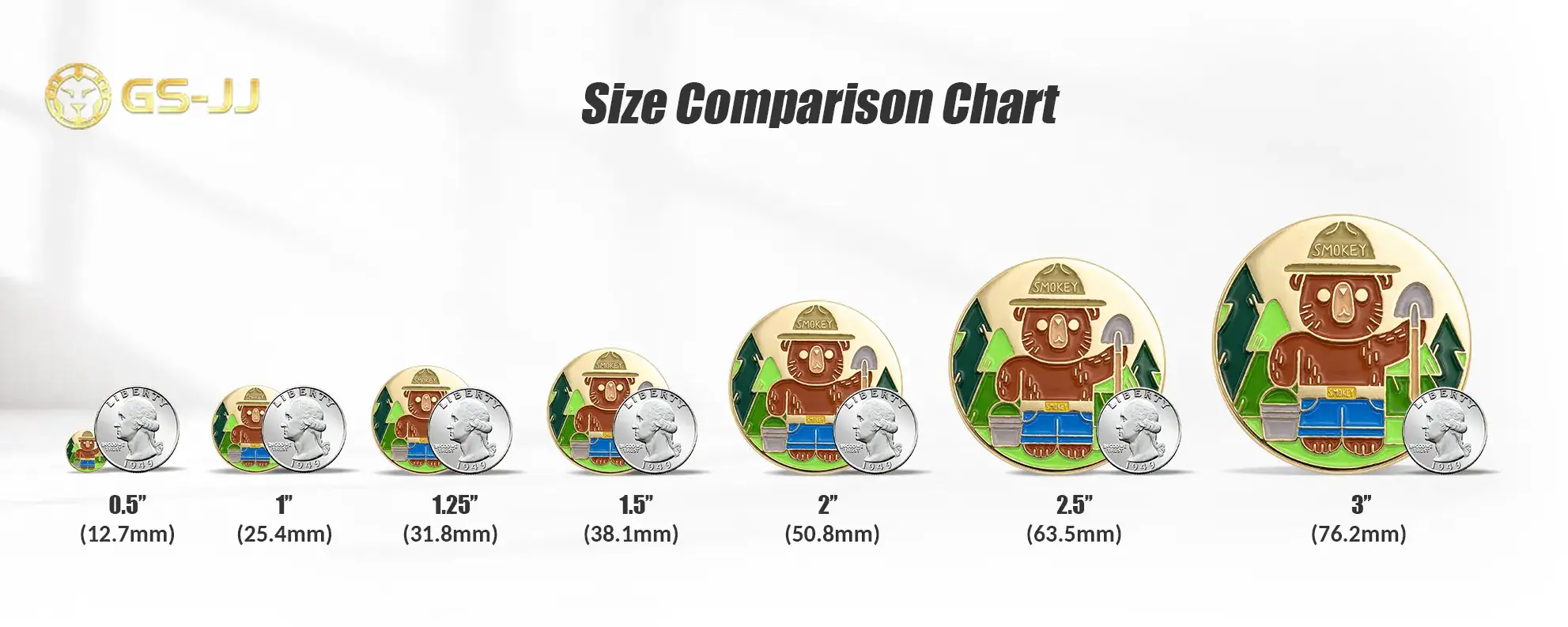
Custom pin sizes are not selected at random; they are determined by the pattern details, the manufacturing process, and the physical structure. Four main factors will directly influence your final choice of size.
1.Design Legibility and Text Scale
If your design includes dense fine lines, complex geometric patterns, or tiny letters, you must choose a larger size; otherwise, the details will become unclear when produced on metal.
- Minimalist Patterns (0.75" - 1.00"): Brand logos or simple geometric shapes take up little space and can still maintain clear and sharp lines at small sizes.
- Complex Designs (≥ 1.25"): Designs that include long slogans, detailed characters, or dense backgrounds require sufficient physical space to carve lines, preventing text from becoming blurry or colors from bleeding into each other.
2.Metal Line Walls and Enamel Filling
Different pin manufacturing processes have strict physical requirements for minimum size. The enamel technique requires metal lines to separate colors, while the printing technique is completely unrestricted by lines.
- Enamel Process Limitation (≥ 1.25"): Hard enamel and soft enamel must rely on metal lines (color separation walls) to divide the pigment areas. If the size is too small, the metal lines cannot form independently, leading to color overflow and mixing.
- Printing Process Alternative (< 0.75"): Offset or Screen Printing (Printed Pins) directly prints the pattern onto the metal surface without metal separation lines, making it the best solution for ultra-small sizes or complex gradient patterns. GS-JJ's design team offers free artwork evaluations to help you choose between enamel and printing.
3.Moving and Interactive Mechanisms
If the pin includes interactive mechanics such as sliding, rotating, or opening and closing, its base size is usually required to be more than 1.5 inches to hide the back rivets and track components.
- Internal Mechanical Space Requirements: Interactive mechanisms require drilled holes inside the pin base to secure the pivot, slide rails, or magnets. If the base size is too small, there won't be enough space to install these physical components.
- Component Durability Assurance: Choosing a bigger size (≥ 1.50") means that the mechanical parts will not become jammed, bent, or break off when being used every day, thus ensuring structural durability.
4.Wearing Scenarios and Garment Placement
Where and how you display your pin determines its ideal size boundary, balancing visual impact with fabric weight capacity:
- Subtle Formal Placement: Business suit lapels, the collars of dress shirts, tie clips, and service awards all need to have compact and lightweight designs so that they lie flat against dress fabrics without tipping forward or pulling on the fine threads.
- High-Impact Merch Placement: Statement pieces intended for use on denim jackets, heavy coats, canvas tote bags, or display boards have the advantage of offering a greater surface area, which provides strong visual impact and increases the retail value of pop-culture merchandise and collectibles.
How to Measure and Test Your Pin Size?
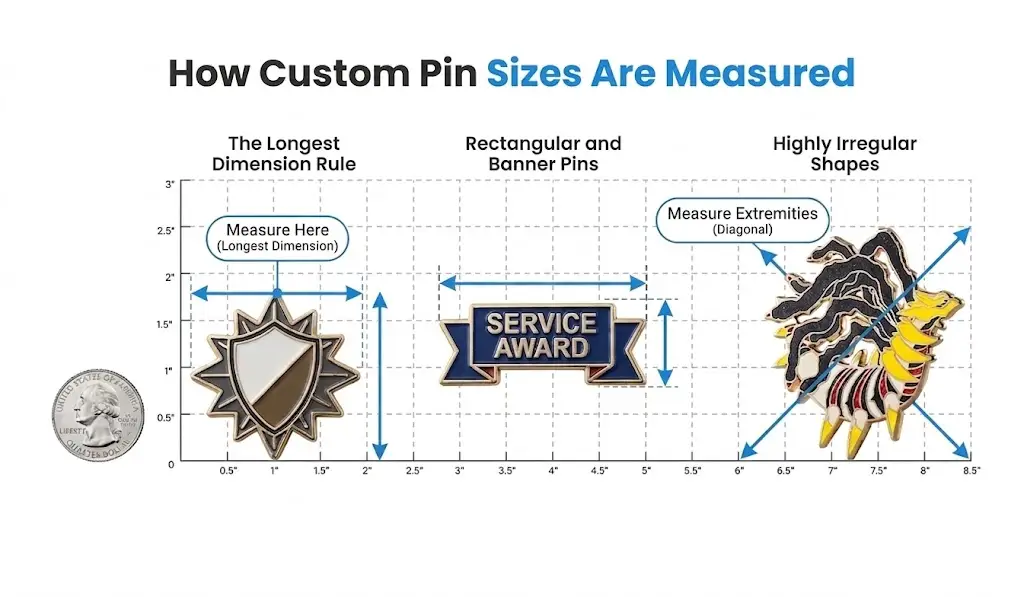
Accurately measuring the size and testing a 1:1 paper cutout before placing an order can effectively avoid size discrepancies and guarantee optimal artwork legibility and garment drape when worn.
1.How Pin Sizes Are Measured?
The size of a custom pin is always determined by the longest single dimension between the farthest edges of the pattern, regardless of the overall shape or tilt direction of the pin.
- The Longest Dimension Rule: Measure the absolute furthest distance between any two outer points on your design, whether that span is height, width, or a diagonal axis.
- Rectangular and Banner Pins: A horizontal pin measuring 1.75 inches wide and 0.5 inches tall is classified and priced strictly as a 1.75-inch pin.
- Irregular and Custom Cut-Outs: For asymmetric logos or character shapes, measure along the longest diagonal line from top to bottom or corner to corner.
2.Tips: The 1:1 Paper Cutout Test
Performing a 1:1 paper cutout test lets you physically evaluate your pin's real-world scale, proportions, and readability on actual garments before entering mass factory production.
- Print at 100% Scale: Print your vector design proof on standard office paper at actual size, making sure printer settings are set to 100% Scale (do not select "Fit to Page").
- Cut and Try It On: Carefully trim along the outer cut-line with scissors, then tape or pin the paper template directly onto the jacket, bag, or hat where it will be displayed.
How Pin Size Affects Wearability on Clothing?
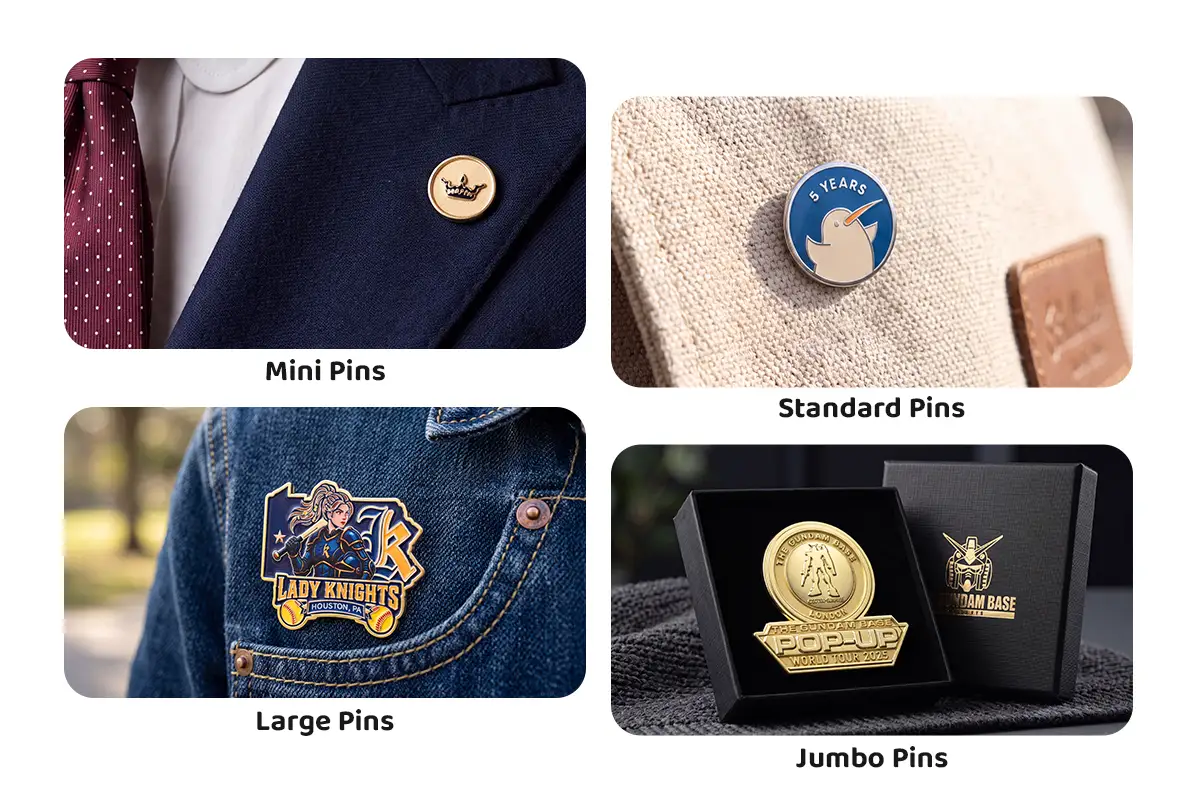 It is important when selecting the pin size to take into account the real situation in which the pin will be used; if the pin is too large or if the pin posts are not properly arranged, the drape of the garment will be compromised, and the pins will sag, tilt, or pull on the fabric threads.
1.Matching Pin Size to Fabric Thickness
Align pin dimensions directly with the weight-bearing capacity of the garment fabric to prevent sagging, dragging, or fabric damage:
- Lightweight Fabrics (< 1.00"): Blouses made of silk, dress shirts, or thin tees do not have rigid tension since the large pins pull on the fine weave, leading to permanent stretch at the holes or to sagging.
- Heavyweight Fabrics (≥ 1.50"): Denim jackets, heavyweight jackets, or canvas bag fabrics are stiff and can easily support large-sized heavy-duty pins, showcasing a strong visual effect.
2.How Pin Size Dictates the Number of Pin Posts?
The size of the pin directly determines the number of pin posts. Pins that are 1.25 inches or larger must be equipped with at least two pin posts to distribute the weight and prevent the pin from rotating or tilting when worn.
- Single Pin (< 1.25"): Regular medium-sized pins only need a single post centered on the back, combined with a rubber or metal clasp to ensure stable wear.
- Dual Pin Posts (≥ 1.25" or Custom Shape): Large or long custom-shaped pins have an unstable center of gravity, and a single pin can cause the pin to spin like a pinwheel. Double pins can lock the angle and ensure the pin remains upright at all times.
How Pin Size Impacts Costs and Expenses?
Size is one of the most critical factors in determining the cost of customization. It not only directly affects the initial tooling fee and unit price but also increases the costs of supporting packaging and subsequent international logistics.
1.Tooling, Material, and Custom Packaging Costs
Increasing the size will directly raise the mold cost and the amount of metal raw materials used. Additionally, heavy-duty pins will require upgraded and thicker protective packaging, further increasing the overall production cost.
- Tooling Fee and Unit Cost: The larger the size of the pin, the larger the area of the steel mold that the factory has to carve, and the more zinc alloy or copper and other metal raw materials are consumed, resulting in a simultaneous increase in the initial tooling fee and the unit production cost.
- Damage Protection Packaging: Large or heavy-duty pins are easily bent during transportation, making it necessary to upgrade to high-weight hard cardboard, shockproof bubble bags, or rigid boxes, which increases the cost per unit of packaging.
2.Weight and Volumetric Shipping Charges
Metal alloys are dense and heavy; as the dimensions of the custom pins increase, the total mass and package volume rise nonlinearly, and the shipping costs for international express delivery therefore increase significantly.
- Increased Metal Weight: Custom lapel pins are high-density metal products, and doubling their size (diameter) will cause their individual weight to increase exponentially. Since international express shipping is charged by weight, this will significantly increase shipping costs as a portion of your total budget.
- Volumetric Weight and Packaging Occupancy: Large lapel pins and their accompanying large, thick packaging materials require more box space, making it easier to trigger the volumetric weight surcharge rules of logistics companies when shipping in bulk.
FAQs
1. What are the best custom lapel pins for detailed logos and how do different production methods compare?
It is best to use printed pins for small details and gradients, since they don't need metal separation lines. Hard enamel gives a smooth, high-quality finish suitable for clear vector logos; soft enamel provides a more dimensional texture at a lower cost; and die-struck is appropriate for colorless metallic designs.
2. Can you recommend different sizes of enamel pins for various uses?
Select 0.75"–1.00" for subtle corporate suits, 1.00"–1.25" for promotional giveaways, 1.50"–1.75" for retail art pins, and 2.00"+ for interactive or high-value collectibles.
3. Where can I find a size chart for lapel pins?
Refer to the comparison table in Section 1 of this guide for everyday coin references, or visit the GS-JJ Size Chart resource page to download printable 1:1 scale templates.
4. What are the standard sizes for lapel pins?
The most common standard lapel pin size ranges from 1.00" to 1.50" (25.4mm to 38.1mm), which delivers the ideal balance between artwork clarity, garment wearability, and budget efficiency.
Conclusion
Although 1.00" to 1.5" are usually the most common size choices for enamel pins, if the design includes intricate patterns, small text, or great detail density, it may be necessary to scale up the overall size or choose processes like offset printing that are better suited for rendering fine elements in order to prevent blurry production outcomes. To help customers better understand the final effect, GS-JJ offers free design support, professional craft advice, and 1:1 scale electronic samples. Let each custom pin be clearly presented before production to ensure the design details can be perfectly reproduced.
Custom Pins Guide: How to Make Enamel Pins Online?
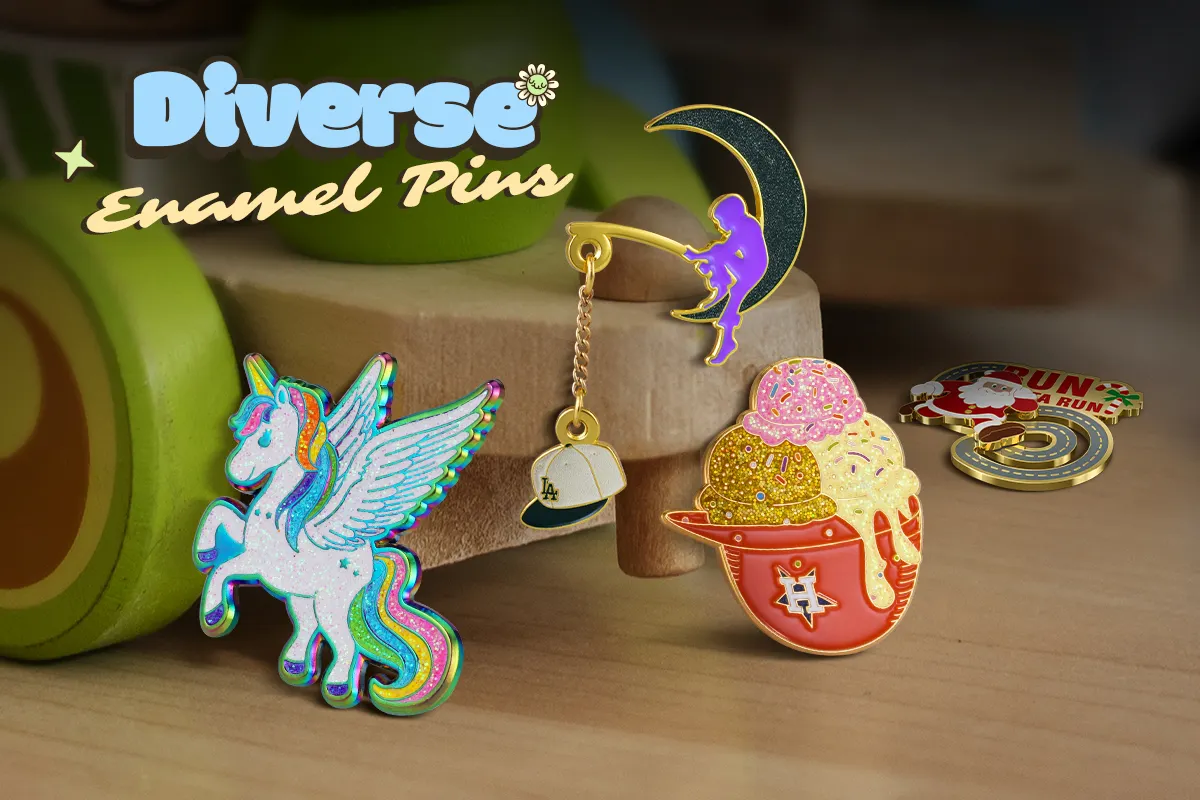
What are Enamel Pins? An enamel pin is a type of pin made by carving grooves into the metal surface and then filling it with different colored enamel pigments. Finally, it is baked at high temperatures to create a brightly colored, wear-resistant, and fade-resistant surface.
Enamel pins are divided into two types: soft enamel and hard enamel. The most fundamental difference between the two types of pins is the surface of the pin. The surface of soft enamel is uneven and has a sense of lines, while the surface of hard enamel is the opposite and has a flat surface.

15 Creative Ways to Use Enamel Pins
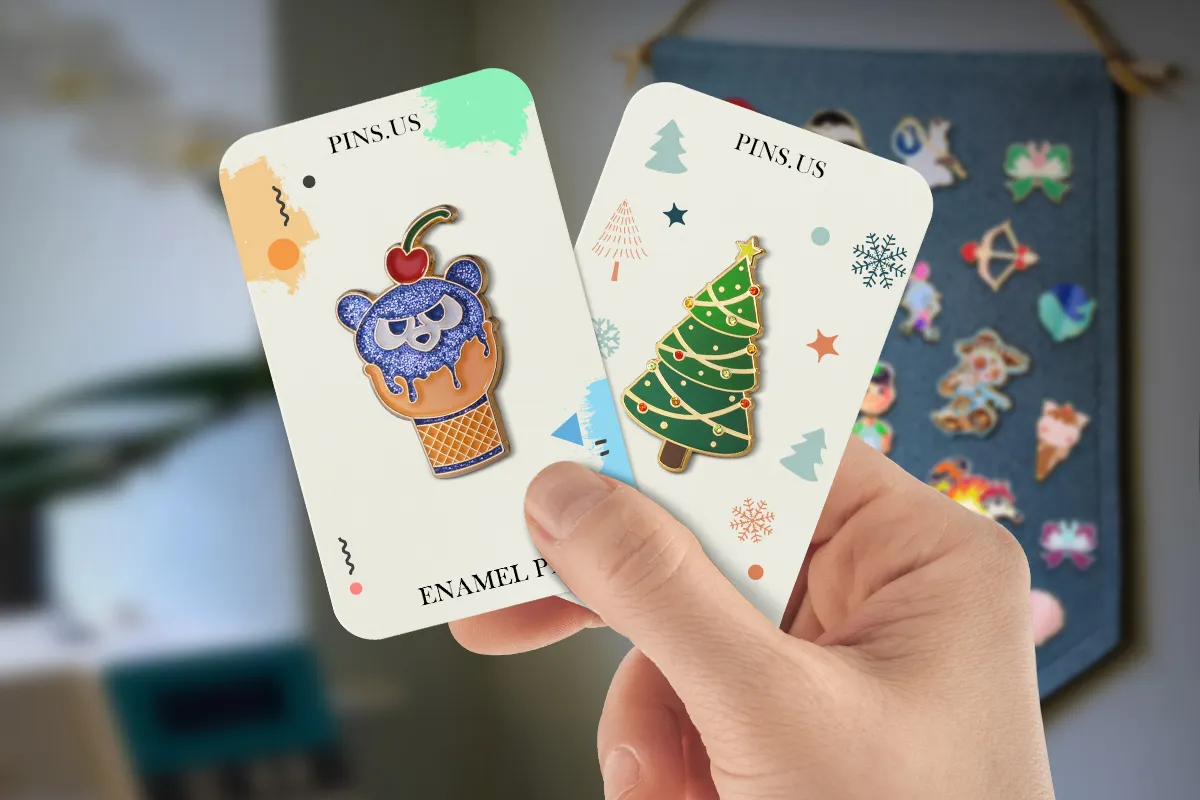
What began as whimsical decorative pins has transformed into objects for self-expression, branding, and creative illustration. With their small size, variety of styles, and durability, they are utilized in fashion, marketing, and daily life in abundance.
Enamel pins are used for more than collecting - they can enhance your personal style, communicate identity, and be used as promotional pins! So here it is: 15 creative and practical uses for enamel pins to inspire you to get the most out of these small and utilitarian little things